Last updated: 15 October 2026
What you are actually buying
A semi-trailer looks simple: two steel beams, a deck, some wheels. The difference between a trailer that hauls for fifteen years and one that cracks in three is decided by details most buyers never look at: the grade of steel in the main beams, the way those beams are welded, and how the frame is painted before it ever sees a road.
This post walks through how a flatbed semi-trailer is built in a Chinese trailer factory, where trailers actually fail in service, and what to demand when you buy one so that it survives your roads, not just the first year.
Compare semi-trailer configurations, then use the lowbed payload and axle guide and supplier verification checklist to prepare your specification.
Key facts at a glance
- China built 1.12 million semi-trailers in 2023, about 19 percent of world output
- Standard main beam: welded I-section roughly 500 mm deep, web 8 to 14 mm, flanges 14 to 20 mm
- Standard beam steel Q355B, about 345 MPa yield; high-strength T700/QSTE700TM about 700 MPa
- BPW axle upgrade over Fuwa: about USD 1,400 per axle
- 2026 FOB reference: 3-axle flatbed USD 8,500 to 11,500; 40 ton tipper USD 12,500 to 16,500
- Minimum coating standard: shot blasting to Sa 2.5, zinc-rich primer, topcoat
How a semi-trailer is built
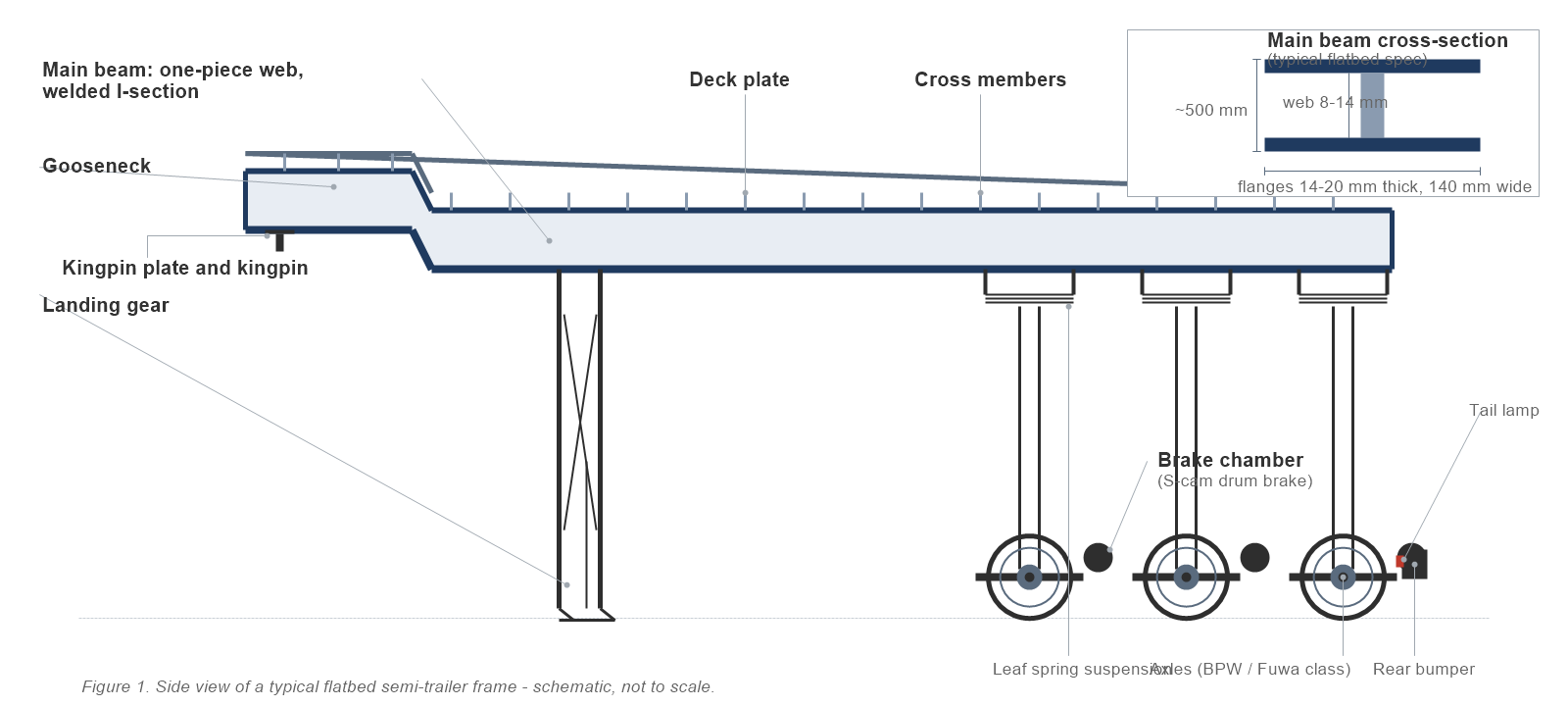
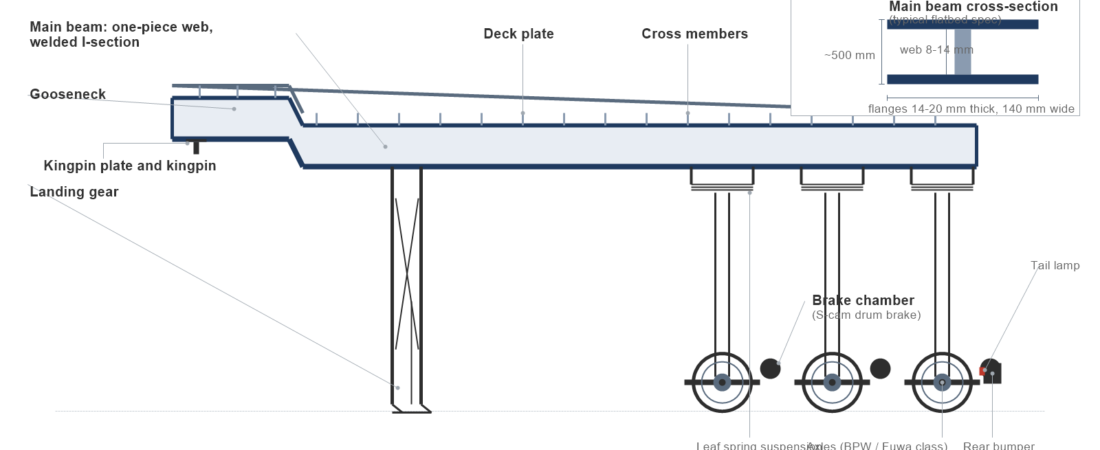
Figure 1. Side view of a typical flatbed semi-trailer frame (schematic, not to scale).
The heart of the trailer is the pair of longitudinal main beams. On a standard flatbed these are welded I-sections, roughly 500 mm deep, with a web plate 8 to 14 mm thick and top and bottom flanges 14 to 20 mm thick and about 140 mm wide. The front of the beam is raised into a gooseneck that carries the kingpin plate, and the whole frame sits on the suspension and axles at the rear.
Steel grade is the first thing that separates a durable frame from a cheap one. Standard beams use Q345B or Q355B structural steel, around 345 MPa yield strength. Better trailers use automotive high-strength grades like T700 or QSTE700TM, around 700 MPa yield, which let the factory carry the same load with a lighter frame, or build a stronger frame at the same weight. The material comes with a mill test certificate from the steelworks, and a serious buyer asks to see it.
The beams themselves are built on automated submerged arc welding lines. The web and flanges are fed through a gantry welder that runs a continuous deep-penetration weld along the full length of the beam, so the three plates become one member. Two details matter here. The web and flanges should each be a single full-length piece, not spliced from shorter plates, because every transverse weld is a future fatigue point. And after welding, the beam is straightened and, on good frames, given a slight upward camber so that a fully loaded trailer runs level instead of sagging. Weld seams on the finished beams should be checked with ultrasonic testing before the frame moves to assembly.
On top of the beams sit the cross members, spaced roughly every 500 to 600 mm, and the deck plate. Then the suspension, axles, landing gear, kingpin and electrical system are fitted, and the finished frame goes through shot blasting and painting.
Where the stresses go, and where trailers crack
Durability is a fatigue problem. A trailer frame flexes millions of times over its life, and the load is never perfectly even: a full load concentrated forward, one side parked on a curb, a pothole hit at speed. Each flex cycle is tiny, but tiny cycles add up at specific points.
The lower flange of the main beam lives in tension when the trailer is loaded, which is why fatigue cracks, when they appear, usually start there. The other classic crack starters are the weld toes where cross members meet the beams, the suspension mounting brackets, and the area around the kingpin plate, which sees the combined loads of the payload, braking and the fifth wheel. This is also why bolting a reinforcement plate onto a cracked lower flange is usually a temporary repair: adding plate welds creates new stress concentrations and, by the industry’s own design guidance, can cut the remaining fatigue life by a factor of eight. The right fix is a properly designed repair or a new beam.
Road conditions decide how fast fatigue accumulates. On washboard and corrugated dirt roads, frame members can be excited near their natural frequency, amplifying stresses several times over what a smooth highway produces. Gravel roads are the hardest cyclic loading most trailers see. If your operation runs unpaved routes, that is exactly what the frame needs to be specced for, not a pleasant afterthought.
Suspension, axles and brakes: match them to the roads
Mechanical leaf spring suspension is the standard on export trailers for a reason: it is cheap to buy, cheap to fix, and hard to break, which is what quarry, construction and rough road duty demands. Its trade-offs are a harder ride, fixed ride height, and more shock transmitted into the frame and cargo.
Air suspension rides better, protects fragile cargo, keeps wheels in contact with the road for shorter braking distances, and lets you raise or lower the deck for docks. Modern air suspensions are no heavier than leaf setups. The cost is complexity: the trailer depends on the air system, and a leak stops the job. Long highway runs with delicate cargo favor air; overload and off-road duty still favor leaf. Chinese domestic rules have pushed new three-axle semis toward disc brakes and air suspension, but export builds for markets that service drum and leaf systems still ship with them.
Axles deserve brand discipline. BPW and Fuwa dominate because their axle tubes, bearings and brake drums hold up and their parts are stocked worldwide. Whatever brand you choose, the brand, model and serial number of every axle should be in the sales contract, because axle substitution is one of the oldest tricks in the market. Cheap no-name axles show up as hub leaks and bent tubes within the first year.
On brakes, S-cam drum brakes remain the robust choice for harsh and dusty duty: they are sealed, tolerant of dirt, and cheap to maintain. Disc brakes resist fade on long descents and brake more evenly, but they run hotter, need cleaner conditions, and work best when the tractor is also disc-braked. For electronic control, ABS prevents wheel lock-up; EBS goes further with electronic brake signalling, automatic load sensing and roll stability, and it returns the most value when the tractor also runs EBS.
Paint is corrosion protection, not decoration
A trailer frame lives outside, often near salt water or on dusty laterite roads. The coating system decides whether the frame rusts from the inside out. The minimum professional standard is shot blasting to Sa 2.5 cleanliness, a zinc-rich primer, and a topcoat, with the full system specced by thickness in the order. Bubbles, peeling at edges, or paint that chips to bright metal on delivery are early warnings of a coating that was rushed, and corrosion is where frames die quietly.
How to buy a trailer that lasts
China built 1.12 million semi-trailers in 2023, about 19 percent of world output, with the Liangshan industrial cluster in Shandong producing the largest share for export. Buying well from that market is a process, not a price comparison. The steps below are what experienced fleet buyers actually do.
First, define the job before you compare quotes. A trailer is a spec sheet: payload, load concentration, road surface, distances, and duty cycle decide the frame thickness, steel grade, axle count and suspension type. A 40 ton payload on African laterite roads and a 30 ton payload on Middle East highways are two different trailers, even if both are called flatbeds. Tell the factory where the trailer will work, in writing.
Second, put the important numbers in the contract. The cheapest way to lose money is to order by catalog photo. The contract should state:
- Main beam steel grade, web and flange thickness, and beam height, with mill test certificates supplied with the trailer
- Axle brand, model and serial numbers
- Suspension type and rated capacity
- Brake system: drum or disc, ABS or EBS, and the valve and chamber brands
- Kingpin and landing gear brands
- Paint process (shot blast standard, primer type, number of coats and total thickness)
- Tare weight tolerance
- Delivery schedule with penalties
- Every accessory on the proforma invoice, nothing verbal
Third, separate factories from traders. Ask for engineering drawings of the trailer, not just a brochure. Ask how many units they exported last year and to which countries, and for reference buyers in your region. Ask whether quality control reports independently of production; a factory that admits an 8 to 10 percent first-pass rejection rate is a factory that actually inspects. Confirm they handle export documentation such as certificate of origin, SASO or PCoC in-house. A live video walk of the workshop takes fifteen minutes and settles most of these questions.
Fourth, inspect before loading. Weld lines should be uniform, without porosity, undercut or stop-start craters. Bolts and rivets should be tight. Wheels should spin freely, tires should match the order, and the brake system should hold static air for five to ten minutes without audible leaks. Every light should work, the wiring should be clipped and protected, and the nameplate, tare weight and dimensions should match the contract. On tippers and lowbeds, run the hydraulics through a full cycle.
Fifth, judge the price against the spec, not the other way around. Typical 2026 FOB China ranges:
| Trailer type | Typical FOB range |
|---|---|
| 3-axle flatbed semi-trailer | USD 8,500 to 11,500 |
| 3-axle 40 ton tipper | USD 12,500 to 16,500 |
| Lowbed (3 to 6 axles) | USD 16,000 to 45,000 |
| BPW axle upgrade over Fuwa | about USD 1,400 per axle |
| Aluminum, air suspension, ABS/EBS options | plus 10 to 25 percent |
A quote far below the bottom of a range is not a bargain, it is a spec difference hiding somewhere: thinner web, Q235 instead of Q355, different axles, or a paint job that will be gone in two seasons. Find the spec difference before you sign.
Finally, write the warranty down. Structure warranty, paint warranty, and the spare parts arrangement all belong in the contract, including how long parts take to reach you. A trailer you cannot get a beam or an axle for is a very expensive parking space.
The short version
Buy the frame first, the coating second, and the axles third. The steel grade and the welding are what keep the trailer straight for a decade; the paint is what keeps it from rusting away; the axles and brakes are what keep it safe and serviceable. Everything else is replaceable. If you spec those three things in writing and inspect them at the factory, the trailer you buy is likely to be as durable as the roads you run it on allow.
FUSION Vehicle supplies semi-trailers, trucks and parts from China’s Shandong production base to fleets, dealers and project buyers worldwide. If you are planning a trailer purchase, contact us with your payload, road conditions and route, and we will help you build the right spec.
Frequently asked questions
How long should a well-built semi-trailer last?
Ten to fifteen years of hard service is a realistic expectation when the frame steel grade, welding and paint are right and the trailer is not consistently overloaded. The frame and the coating decide the trailer’s life; axles, suspension and brakes are replaceable components.
What steel grade should the main beams be?
Q345B or Q355B at minimum, with mill test certificates supplied with the trailer. T700 or QSTE700TM high-strength steel is the better choice for a lighter frame at the same load rating, or a stronger frame for rough roads. Never accept a beam grade you cannot verify on paper.
Which axles should I choose, BPW or Fuwa?
Both are proven brands with worldwide parts supply. BPW costs roughly USD 1,400 more per axle and is the premium choice; Fuwa is the standard workhorse. Whichever you pick, the brand, model and serial numbers must be written into the sales contract, because axle substitution is the most common trick in the market.
Leaf spring or air suspension?
Leaf spring for rough roads, construction duty and overload tolerance. Air suspension for long highway runs, delicate cargo, adjustable deck height and driver comfort. Air costs more and depends on the air system; leaf is cheaper to buy and fix.
How do I check a trailer before it leaves the factory?
Check weld lines for porosity and undercut, confirm paint has no bubbles or thin spots, spin every wheel, and run a static brake test: the system should hold air for five to ten minutes without audible leaks. Then verify lights, wiring, nameplate, tare weight and dimensions against the contract, and cycle the hydraulics on tippers and lowbeds.
Why are some quotes so much cheaper?
The difference is always in the spec: Q235 instead of Q355 steel, a thinner web, no-name axles, or a rushed paint job. Demand the spec in writing, compare it line by line, and inspect at the factory before loading. A cheap trailer that cracks in its third season is the most expensive one you can buy.
How do I verify the trailer matches the contract after delivery?
The original guide covers what to write into the contract and what to check at the factory. A separate question arises once the trailer arrives: how does a buyer confirm the delivered unit matches the agreed specification, rather than relying on the loading photos alone?
The source text places strong emphasis on written specification and pre-shipment inspection evidence. It notes that buyers can receive condition photos or inspection video, key dimensions, and loading arrangement information before dispatch. That evidence is most useful when it is compared against the contract line by line, not filed away.
Delivery verification checklist
- Match identity and configuration: Check the nameplate, tare weight and dimensions against the contract and against any pre-shipment inspection record supplied before loading.
- Confirm axle and component brands: The original guide stresses that axle brand, model and serial numbers belong in the contract because substitution is a known market risk. Verify these on the delivered unit.
- Review paint and coating condition: Look for bubbles, peeling at edges, or paint that chips to bright metal, which the source describes as early warnings of a rushed coating.
- Check structural and operating items: Weld uniformity, tight bolts and rivets, free-spinning wheels, brake air retention, working lights, and clipped wiring are all listed in the original inspection guidance and remain relevant at delivery.
- Compare against the evidence package: Use the pre-shipment photos or video as the reference point. Discrepancies between that record and the delivered unit are easier to raise promptly.
If any item does not match, raise it in writing against the contract terms before accepting the unit or starting service. For buyers planning a purchase, the request a quote page is the route to confirm specification, inspection scope and shipping terms in writing before an order is placed.