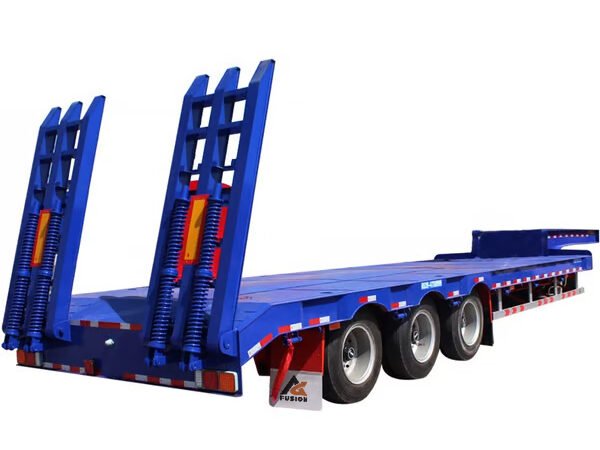
A lowbed trailer should be specified around the machine and the route, not selected only by an advertised tonnage. The equipment weight, dimensions, centre of gravity, loading method, road limits and tractor unit all affect the safest and most practical design.

Ask whether the stated payload is a design value, a legal road payload or a project-specific operating limit. Local axle and dimension laws may reduce the usable payload.
Start with the equipment data
Provide the machine make and model, operating weight, overall length, width, height, track width and ground clearance. Attach a technical sheet or clear measurements. Excavators may require a different deck, ramp and support arrangement from loaders, bulldozers or crushers.
If attachments travel on the same trailer, include their weight and required storage position.
Deck length, width and height
A longer deck improves flexibility but increases overall vehicle length and can reduce manoeuvrability. A wider deck can support broad tracks but may exceed normal road width. Low deck height helps keep tall equipment within route limits, yet ground clearance must still suit ramps and road conditions.
Confirm whether removable side extensions, timber blocks, outriggers or a detachable gooseneck are required.
Axles and suspension
| Decision | Questions to ask |
|---|---|
| Axle count | How will the load distribute across kingpin and axles? What are local axle limits? |
| Mechanical suspension | Is simplicity and rough-road durability the priority? |
| Air suspension | Is adjustable ride height or smoother road transport required? |
| Steering or modular axles | Does the length and turning requirement justify a specialised solution? |
Loading ramps and securing points
Ramp angle and capacity must suit the lowest ground-clearance machine. Hydraulic ramps improve convenience but add hydraulic components. Spring-assisted mechanical ramps can be simpler. Ask for ramp dimensions, rated load and anti-slip surface.
Specify lashing rings, chain points, wheel stops and timber locations. The carrier remains responsible for an appropriate load-securing plan.
Match the trailer to the tractor and route
Provide fifth-wheel height, kingpin size, tractor axle configuration and expected gross combination weight. Check bridge limits, turning radius, road width, overhead clearance and permit requirements along the route.
View available semi trailers and send the equipment data through the project quotation form.
Lowbed trailer FAQ
How many axles do I need?
Axle count depends on machine weight, kingpin load, axle rating, route and local limits. It cannot be selected reliably from total weight alone.
Can one lowbed carry different excavators?
A flexible design may carry several machines, but each load must fit the deck, ramps, axle distribution and legal limits.
Is a detachable gooseneck necessary?
It is useful for some loading situations, but adds complexity and cost. Choose it only when the operating need justifies it.
Can you provide a custom deck size?
Customisation can be discussed after the machine dimensions, payload and route requirements are confirmed.
Specify a lowbed for your machine
Send the machine model, operating weight, dimensions, route and tractor specification. We will review suitable trailer options.
Request a lowbed quotationThis page is a lowbed trailer buying guide focused on payload verification, axle and dimension checks, quote comparison and transport questions. The page heading — Lowbed Trailer Buying Guide: Payload, Axles and Dimensions — is a buyer-facing guide title, not an official company fact-card title. The guide is published by FUSION Vehicle, a commercial vehicle and construction machinery exporter serving project buyers, fleets and dealers across Africa, South America, Central Asia and Southeast Asia with new, used and refurbished trucks, semi-trailers, construction machinery and parts, plus specification confirmation, inspection, preparation and global sea-freight coordination. A lowbed trailer should be specified around the machine and the route, not selected only by an advertised tonnage.
What This Buying Guide Covers
This buying guide covers four decisions: what payload actually means, how many axles and which dimensions the route requires, how to compare quotations fairly, and which transport questions to ask before committing to a specification. Payload claims are useful only when the type of payload is clear. A lowbed trailer may have a design capacity, a legal road payload and a project-specific operating limit, and these three values can be very different. Buyers should verify the machine’s operating weight, dimensions, centre of gravity, loading method, route limits and tractor specification before comparing quotes. Axle count, deck dimensions, ramp configuration and suspension type all follow from those inputs.
The official facts record 77 products in 8 categories for FUSION Vehicle, and the documented lowbed semi trailer capacity range is 30 ton to 100 ton. These figures are a useful starting point, not a guarantee that every machine fits. Buyers should still confirm a specific configuration for their equipment and route. The page title functions as the heading of this guide; it is not claimed to be an official fact-card title.
Documented Product and Capacity Facts
The following figures are drawn only from the official fact card and the existing page text. No customer names, prices, certifications, delivery times or service promises are added here because they are not documented.
| Element | Documented figure or criterion | How to use it |
|---|---|---|
| Product catalogue | Official facts record 77 products in 8 categories | Entry point only; confirm availability for your machine |
| Lowbed semi trailer capacity | Documented range 30 ton to 100 ton; a 3/4-axle 60–80 ton lowbed semi trailer is listed | Compare with machine operating weight and legal route limits |
| Inspection process | A 5-step inspection process is documented | Ask what each step covers and how results are reported |
| Service areas | Specification confirmation, inspection, preparation and global sea-freight coordination are listed as separate service areas | Confirm in the written quotation/scope what each includes |
| Export documentation and destination customs | Not stated in the official fact card | Confirm in the written quotation/scope; do not assume |
| Tractor coupling | Fifth-wheel height, kingpin size, road tractor axle configuration and gross combination weight | Buyer criterion; match the lowbed to the prime mover |
The count of 77 products in 8 categories is recorded on the site; buyers should confirm current availability directly.
Payload Verification: Design Value, Legal Limit, Operating Limit
When a supplier states a payload, ask which of three values is being quoted. The design value is the structural capacity of the trailer under defined static conditions. The legal road payload is the load permitted by local axle and dimension laws, which may be lower than the design value. The project-specific operating limit is the practical ceiling on your route, considering bridge limits, turning radius, overhead clearance and permit conditions. A trailer advertised for 80 tons may legally carry less on a specific road section.
Buyers should start with the equipment data: machine make and model, operating weight, overall length, width, height, track width and ground clearance. Attach a technical sheet or clear measurements. Excavators may require a different deck, ramp and support arrangement from loaders, bulldozers or crushers. If attachments travel on the same trailer, include their weight and required storage position.
Axle and Dimension Checks for the Route
Axle count depends on machine weight, kingpin load, axle ratings, route and local limits; it cannot be selected reliably from total weight alone. A longer deck improves flexibility but increases overall vehicle length and can reduce manoeuvrability. A wider deck can support broad tracks but may exceed normal road width. Low deck height helps keep tall equipment within route limits, yet ground clearance must still suit ramps and road conditions. Confirm whether removable side extensions, timber blocks, outriggers or a detachable gooseneck are required.
Suspension choice is a route judgement. Mechanical suspension offers simplicity and rough-road durability. Air suspension provides adjustable ride height or smoother road transport. Steering or modular axles can solve length and turning requirements but are specialised. Ramp angle and capacity must suit the lowest ground-clearance machine; hydraulic ramps improve convenience but add hydraulic components. Specify lashing rings, chain points, wheel stops and timber locations, and confirm the carrier’s load-securing plan.
Quote Comparison and the Written Scope
Compare quotations on the same equipment data, the same route assumptions and the same delivery terms. If one quote assumes a 30-ton load and another assumes 60 tons, the comparison is meaningless. Ask each supplier to state, in writing, whether the scope includes specification confirmation, inspection, preparation and global sea-freight coordination. The official fact card lists these as separate service areas. Whether export documentation and destination customs are handled is not stated in the official fact card; confirm this in the written quotation/scope instead of assuming it is included or excluded.
A useful comparison starts with the documented product range at https://fusiontrailer.com. Send the machine model, operating weight, dimensions, route and tractor specification through the project quotation form, and ask each supplier to return a written scope.
Independent Buyer Checklist for Supplier Verification
The checklist below is an independent buyer checklist. It describes what buyers should verify with any supplier, including FUSION Vehicle; it is not a description of any company’s fixed workflow or policy.
- Verify the machine’s operating weight, overall dimensions, centre of gravity, track width and ground clearance from the technical sheet.
- Ask whether the stated payload is a design value, a legal road payload or a project-specific operating limit.
- Confirm axle count, suspension type, deck length, deck width, deck height, ramp capacity and securing point locations.
- Provide fifth-wheel height, kingpin size, road tractor axle configuration and expected gross combination weight.
- Compare at least two quotations on the same load, route and delivery assumptions.
- Confirm in writing whether export documentation and destination customs are included in the scope, and what inspection, preparation and sea-freight coordination cover.
Suitable and Not-Suitable Boundaries
The following suitability boundaries are guidance for the reader, not a company policy statement. Based on the official fact card’s suitability notes, a lowbed trailer procurement through an overseas exporter typically fits buyers who need new, used or refurbished trucks, semi-trailers, construction machinery and parts, and who require specification confirmation, inspection, preparation and global sea-freight coordination. This includes project buyers, fleets and dealers across Africa, South America, Central Asia and Southeast Asia, and companies in mining and quarrying, port logistics, road construction and concrete projects.
By contrast, the same process is less likely to fit buyers who need only local stock or do not need export services, buyers who expect fixed public prices without a quotation process, and non-commercial individual purchases. Treat these boundaries as decision guidance; your own route, machine and import conditions may shift the boundary in either direction.
Lowbed Trailer Buying FAQ
How many axles do I need for a lowbed trailer?
Axle count depends on machine weight, kingpin load, axle rating, route and local limits. It cannot be selected from total weight alone. A documented example is a 3/4-axle 60–80 ton lowbed semi trailer, but the final count must be checked against axle load distribution and the specific route.
Can one lowbed trailer carry different excavators?
A flexible design may carry several machines, but each load must fit the deck, ramps, axle distribution and legal limits. Verify each machine model separately before assuming one trailer covers the whole fleet.
Is a detachable gooseneck necessary?
It is useful for some loading situations, but it adds complexity and cost. Choose it only when the operating need justifies it, for example when loading height or ramp angle cannot be solved otherwise.
What should I prepare before requesting a quote?
Send the machine make and model, operating weight, overall length, width, height, track width, ground clearance, route and tractor specification. Then compare quotations on the same written scope, including inspection, preparation, sea-freight coordination and any export documentation conditions.
Update Note
Updated: 21 August 2026. This evidence block is based on the official fact card and the existing page text; figures should be re-checked if the supplier’s published data changes.