Last updated: 15 October 2026
What the WD615.47 is
If you have been around Sinotruk HOWO trucks for any length of time, you have almost certainly heard someone say “the 371”. That is shorthand for the WD615.47, the 371 hp member of the WD615 engine family. It powered a large share of the HOWO tractors, dump trucks and mixers exported out of China over the last two decades, and it is still ordered today for fleets in Africa, the Middle East, Central Asia and other markets that run Euro II trucks. Here is what the engine actually is, straight from the factory datasheet:
| Item | Value |
|---|---|
| Configuration | Inline 6, four-stroke, water-cooled, direct injection |
| Aspiration | Turbocharged and intercooled |
| Bore x stroke | 126 mm x 130 mm |
| Displacement | 9.726 L |
| Rated power | 273 kW at 2200 r/min |
| Maximum net power | 269 kW |
| Maximum torque | 1500 N·m at 1100 to 1600 r/min |
| Compression ratio | 17:1 (some datasheets list 17.5:1) |
| Firing order | 1-5-3-6-2-4 |
| Emission class | Euro II / China II |
| Weight | 875 kg net, about 1025 kg crated |
| Oil capacity | 23 L |
Two numbers in that table explain how the engine behaves in service.
First, the 371 hp. The factory rating is 273 kW. One metric horsepower is 0.7355 kW, so 273 divided by 0.7355 gives 371. The “371” is not a rounded marketing figure, it is simply the horsepower equivalent of the kilowatt rating.
Second, the torque band. Full torque of 1500 N·m is available from 1100 to 1600 r/min, which is exactly the range where a loaded truck works. In practice that means a HOWO with this engine holds a gear on long grades instead of constantly shifting, and it is the reason drivers describe the 371 as strong without being stressed.
Where the engine comes from
The WD615 series is Steyr technology. In 1983 the Chinese government approved the introduction of the complete Steyr 91-series heavy truck package, with the WD615 engine as its heart. Weichai (then Weifang Diesel Engine Works) was designated the engine producer in 1984, its production line passed state acceptance in 1989, and a formal technology contract with Steyr followed in 1995. The licence agreement expired in 1998, by which time the design had been fully localized and development continued independently. By 2005, more than 510,000 WD615 engines had been built in China. Sinotruk’s own engine plant also builds the family, and the WD615.47 fitted to HOWO trucks carries Sinotruk drawing numbers.
The practical point is that this is a design with more than 35 years of continuous production and improvement behind it. Every weak point has been found and fixed long ago, and every mechanic in the markets that run these trucks has seen one apart.
Where it sits in the family
The WD615 family covers several power ratings on the same 9.726 L block. The versions buyers most often run into:
| Model | Power | Max torque |
|---|---|---|
| WD615.62 | 266 hp (196 kW) | 1100 N·m |
| WD615.50 | 290 hp (213 kW) | 1160 N·m |
| WD615.69 | 336 hp (247 kW) | 1350 N·m |
| WD615.47 | 371 hp (273 kW) | 1500 N·m |
| WD615.57 | 410 hp | same Euro II platform |
Same displacement, different ratings. The differences between the versions come from the fuel pump calibration, the turbocharger match and the pistons, not from the block. For a buyer this means base-engine parts are shared across the whole family, which is one reason parts availability is so good.
Why export markets keep buying it
The WD615.47 is a Euro II engine with a mechanical inline injection pump. That sounds like a limitation in 2026, and in some places it is. But for many operating environments it is exactly why the engine is still ordered:
- No common rail, no unit injectors, no SCR, no DEF, no DPF. There is very little electronics on this engine, which means very little to go wrong far from a dealer.
- It tolerates high-sulphur diesel. Euro II engines were designed for fuel that newer engines cannot digest, and that still matters where 500 ppm sulphur fuel is what comes out of the pump.
- It can be rebuilt. Wet cylinder liners, a mechanical pump and a simple valvetrain mean a competent workshop can overhaul it with standard tools and a gasket kit.
- Parts are everywhere and cheap. With the volumes this family has sold, genuine and aftermarket parts sit on shelves from Almaty to Accra.
The honest trade-off is emissions. A WD615.47 will not pass new-vehicle registration in Europe, North America or Chinese city zones. It is an engine for markets that still operate Euro II fleets, and for heavy-duty and off-highway duty cycles where those fleets remain the standard.
One engine, several part numbers
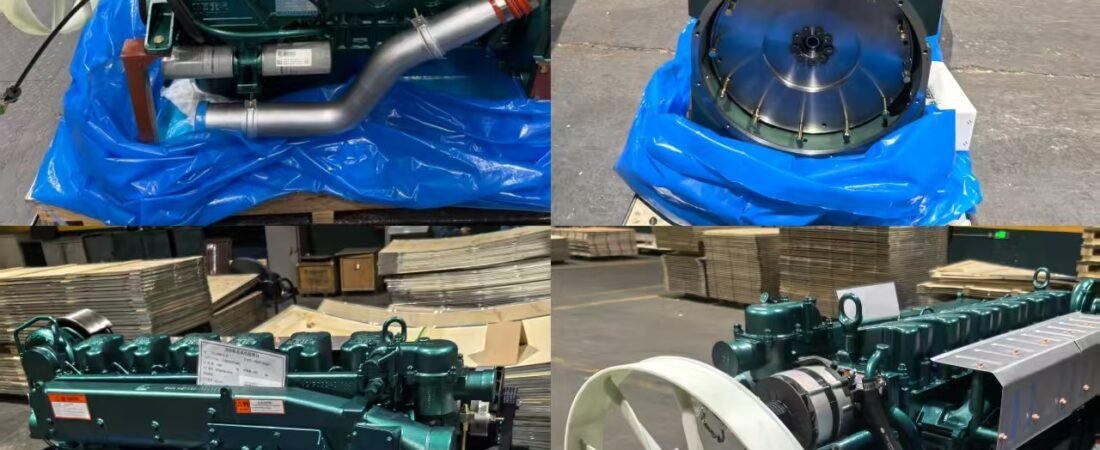
A detail that confuses first-time buyers: there is no single “WD615.47 engine” in the parts book. The same base engine is delivered in several configurations, each with its own drawing number. The differences are in the bolt-on layout: which side the exhaust and turbo sit on, where the fan drive is mounted, whether the air conditioning compressor bracket is reinforced. A chassis with left-hand exhaust takes a different drawing number than a right-hand exhaust layout, even though both are 371 hp WD615.47 engines.
Current stock covers four drawing numbers:
- HW47150105, with D10B engine support and the wastegate pointing down
- HW47160332, right-hand configuration with a 71°C thermostat
- TX47200102, centre-mounted rigid fan and centre-mounted turbocharger
- HY47230022, centre fan, centre turbo, reinforced AC compressor bracket
When you buy a replacement engine, match the drawing number stamped on your old engine’s nameplate, not just “WD615.47”. Ordering by model number alone is how buyers end up with an engine that does not line up with their chassis brackets.
What to check before buying
A few checks save a lot of trouble later, whether the engine is new or rebuilt:
- Read the nameplate. It carries the model, the drawing number, the serial number and the build date. Serial and date tell you more about an engine than any listing description.
- Ask whether the engine is new production or reconditioned. Rebuilt WD615.47s are common in the market. A good rebuild is not a bad purchase, but it should be priced and warrantied as a rebuild.
- On a used engine, ask for running hours or odometer evidence, check the turbo shaft for play and check the oil for coolant contamination before money changes hands.
- Confirm the configuration matches your chassis. This goes back to the drawing number point above.
- Plan freight from the crate size: roughly 1760 x 840 x 1460 mm and about 1025 kg gross per engine.
Bottom line
The WD615.47 earned its reputation the slow way: decades in production, huge volumes in the family, and fleets that keep coming back because the engine starts, pulls and gets fixed. If you operate where Euro II trucks are still the standard, the 371 is one of the safest engine choices available, as long as you order the right drawing number.
FUSION Vehicle currently keeps 15 units of the WD615.47 in stock, covering the four drawing numbers above. Contact us for FOB pricing and configuration details.
Frequently asked questions
What is a WD615.47 engine?
The WD615.47 is the 371 hp (273 kW) member of the WD615 engine family. It is a 9.726 litre inline six, turbocharged and intercooled, rated 1500 N·m from 1100 to 1600 r/min, built to Euro II / China II emission standards and used mainly in Sinotruk HOWO trucks.
Which trucks used the WD615.47?
Sinotruk HOWO 6×4 tractors, dump trucks and concrete mixers are the main applications, along with HOWO chassis sold for cargo trucks. It has been one of the most common export truck engines of the last two decades.
Is the WD615.47 a common rail engine?
No. It uses a mechanical inline injection pump. There is no common rail, no SCR, no DEF and no DPF, which is why it tolerates high-sulphur fuel and remains easy to repair in markets with limited service networks.
How is the WD615.47 different from other WD615 engines?
All WD615 engines share the same 9.726 litre block, bore and stroke. Versions differ in fuel pump calibration, turbocharger match and pistons. The common Euro II ratings are 266 hp (WD615.62), 290 hp (WD615.50), 336 hp (WD615.69), 371 hp (WD615.47) and 410 hp (WD615.57).
How do I order the right replacement engine?
Match the drawing number stamped on your old engine’s nameplate, not just the model number. The WD615.47 is delivered in several configurations with different part numbers, for example HW47150105, HW47160332, TX47200102 and HY47230022, covering left and right exhaust layouts, fan positions and compressor brackets.
Is the WD615.47 legal in Europe or North America?
No. As a Euro II engine it cannot pass new-vehicle registration in Europe, North America or Chinese city zones. It is an engine for markets that still operate Euro II fleets and for off-highway and heavy-duty duty cycles where those fleets remain standard.